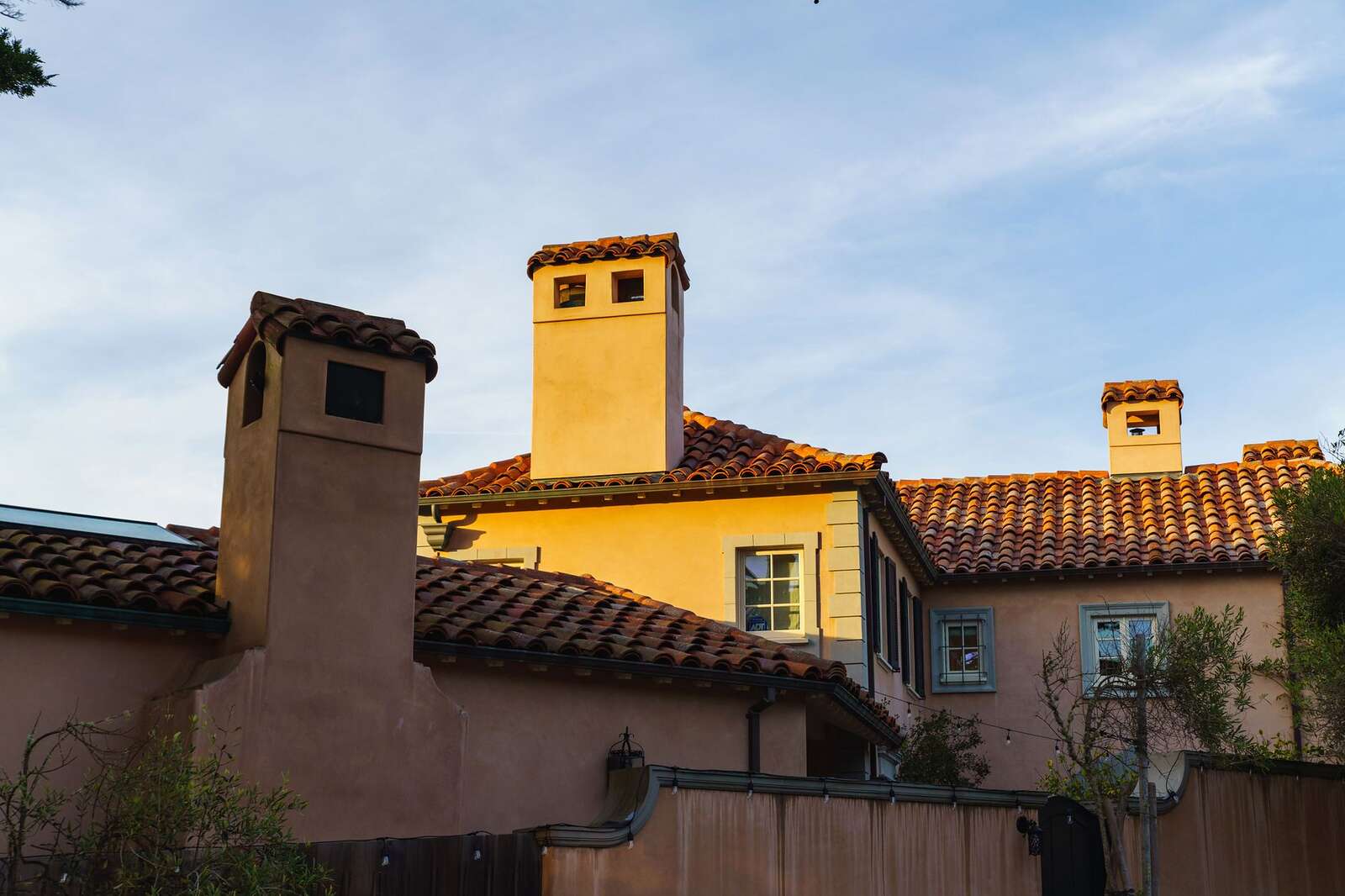
Rodent Removal in Kensington and Talmadge
Kensington and Talmadge were built out in the late 1920s and 1930s in Spanish Revival with clay tile, on lots that back onto canyons where roof rats live year round. There is no charge for the inspection and the phone is staffed day and night.
- Free tile eave and attic inspection
- Metal bird stops, no foam
- Branch 2 registered contractors routed
Clay tile eaves are the front door in Kensington and Talmadge
The Spanish Revival houses that fill Kensington and Talmadge carry clay tile roofs, and the gap under the first course of tile at the eave is where most roof rats enter. Kensington's map was filed in 1910 and its housing stock is mostly late 1920s; Talmadge Park was laid out in the same decade and its original tract was added to the National Register of Historic Places in 2024. On both sides of Fairmount Avenue the roofs are the same age, and a bird stop that was fitted in 1928 has had close to a century to rust, crack or fall out. Where it has, the void under the tile runs the length of the eave and a rat has a covered corridor straight into the attic.
The fix is the same component the builder used, in modern metal. A bird stop, or eave closure, is a code-approved metal part, usually 26 gauge galvanized steel or aluminum, sometimes ventilated with weep holes, and the US Department of Energy lists fitting bird stopping among its recommended measures for tile roofs. A cheap quote for the same eave usually means a blob of expanding foam pushed under the tile, and foam is chewed through within a season. Rodent exclusion on a Kensington or Talmadge roof means metal closures along every eave, fitted under the tile so the street view is unchanged.
Canyon-rim lots have a permanent supply next door
Both neighborhoods sit on mesa tops edged by canyons, and the houses along the rims share a boundary with year-round roof rat habitat. Ward Canyon, once Kensington's western edge, now lies under the freeway, but the finger canyons that cut into the rim streets are still open, still wet at the bottom in the rainy season and still full of the cover a rat wants. The slopes below the rim houses are planted with ivy, bougainvillea and mature trees, and the county's own guidance names ivy, dense vines, palms with dead-frond skirts and citrus as the places roof rats nest before they move to a roof.
A rat that lives on the slope has several routes to the eave. A branch over the roof, a fence top that runs to the garage wall, the cable and phone lines that come in at the corner of the house, a palm trunk beside the patio. Roof rats are climbers and use each of these as a road, according to the University of Florida extension, which also puts their normal range at about 150 yards from where they nest. Cutting the branch back and trimming the palm skirt takes away the easy road. It leaves the canyon full, which is why the house itself gets sealed. Roof rat removal on a rim lot is trapping inside plus metal at every opening, in that order.
The crawl space is the second attic
Most 1920s houses in Kensington and Talmadge stand on a raised foundation with a crawl space, and the crawl space is inspected as carefully as the attic because rats use it the same way. Foundation vents sit around the perimeter at grade, and the original screens are thin wire that rusts through. A vent behind a shrub that nobody has looked at in years is an opening. Once inside, the rat has the underside of the whole floor to travel and the plumbing chases to climb.
A full inspection here has three parts: the crawl space with a light along every vent and the sill, the attic with a look at the top plates for droppings, and the roofline from a ladder with each eave checked for its bird stop. The contractor we route writes each opening down with a price beside it. The homeowner who wants a documented starting point before any work can book the rodent inspection on its own; it is free either way. Being told by a neighbor that a few rats are normal in a canyon neighborhood does nothing for the person lying awake under them. The contact page and the phone, answered 24 hours a day, both start the same process.
A representative bird stop replacement on a Kensington tile eave
On a Kensington or Talmadge eave the original bird stop is often a run of mortar or a strip of thin metal that has crumbled between the tile pans. A representative replacement lifts the first course, cleans out what is left of the old closure, fits a new galvanized eave closure shaped to the tile profile along the full run, and re-lays the tile over it. The same ladder visit checks the ridge and hip tiles for lifted ends, the point where the roof meets the chimney, and the gable vents for screen.

Why mice keep coming back
A look at the openings that make it repeat.
Video: EASY WAY to Get Rid of Mice in Your House FOREVER, from Silver Cymbal.
Why Kensington and Talmadge homeowners book through us
The right part under the tile
A tile eave in Kensington or Talmadge gets a manufactured metal bird stop, which is the code-approved closure the Department of Energy recommends for tile roofs, fitted along every eave and hidden under the first course. The contractor we route prices it by the linear foot so the homeowner can see what the roof costs on its own. Foam has no place on these roofs; it fails and it shows. Ask whoever attends what closure they use and to bring a sample.
US Department of Energy: bird stopping is a recommended tile roof measure
Poison is off the table at a house, so traps go in
California's AB 1788 removed the second-generation anticoagulants from residential use in 2021, and AB 1322 added the first-generation bait diphacinone from January 2024, both explained in the California Department of Pesticide Regulation's Q&A pages. What that leaves for a licensed contractor at a Kensington house is narrow, and the practical method is snap traps in the attic and crawl space. The University of Florida extension also notes that trapping avoids the risk of a poisoned rat dying inside the building, which in a 1920s wall is a smell nobody wants.
AB 1788 and AB 1322, California Department of Pesticide Regulation
The registration is on the state board's site
Every company we route holds the Structural Pest Control Board Branch 2 registration that rodent work in California requires. Ask whoever attends for the PR number and look it up at pestboard.ca.gov before the first visit. The county's Vector Control program will also come out for a free outdoor educational inspection, at (858) 694-2888, and hands out a Rat Control Starter Kit, though it does not trap or seal. The contractors we route pick up where that visit ends, with the trapping, the sealing and any attic work.
Structural Pest Control Board Branch 2, PR number at pestboard.ca.gov
A typical Talmadge call
The situation: A late 1920s Spanish Revival house on a rim street in Talmadge, clay tile roof, a queen palm beside the patio with two seasons of dead fronds hanging in a skirt, and a slope of ivy down to the canyon. The owners have been hearing a scramble across the ceiling above the hallway every night since the first rain of October. They have bought two plug-in devices and a box of bait blocks from a hardware store and the scramble has continued.
What gets done: The inspection finds the bird stop gone along the whole rear eave and a run of droppings on the top plate inside, along with gnaw marks on the edge of the attic hatch. The palm skirt shows a nest. The bait blocks are removed, because a rat that dies in a 1920s wall stays there. Snap traps go in for a week. The rear and side eaves get galvanized bird stops under the first course, the gable vent gets hardware cloth from inside, and the owners have the palm skinned and the ivy cut back from the fence by their gardener.
How it turns out: Three roof rats come out of the attic in the first six nights and nothing follows. The follow-up visit finds the seals intact and no new droppings. The hallway is quiet, and the owners keep the palm trimmed every spring, which is the part of the job that stays theirs.
Kensington and Talmadge rodent questions
These are the questions that come up on rim-street calls in both neighborhoods.
Why do rats keep coming back to my house on the canyon?
Because the canyon is where they live and your house has an opening. The wet canyon bottoms in Kensington and Talmadge hold roof rats all year, and a rat forages about 150 yards from its nest, so every rim house is within range. Trapping alone removes the rats that are inside this month; the canyon replaces them. What ends the cycle is closing every opening with metal, the tile eaves first, then the vents and the utility penetrations, so the next rat up the slope finds nothing open. Trimming trees and palms makes the climb harder and is worth doing as well.
Can I just have the palm trimmed?
Trim it, and expect it to help without solving the problem. A queen or fan palm with a skirt of dead fronds is a nesting site the county names, and skinning it removes that nest and the easy climb to the roof. The rats that were in it move to the ivy, the citrus or the neighbor's palm and still know where the eave gap is. The palm work and the sealing go together. Ask whoever attends to list the roofline openings and price them, and have the palm and the ivy done by your gardener in the same couple of weeks.
Does the sealing show from the street?
No. A bird stop sits under the first course of tile and reads as part of the roof, gable vents keep their wooden louvers and get hardware cloth on the attic side, and foundation vents keep their original frames with new screen inside. This matters in Talmadge, where the original tract is a listed historic district, and in Kensington's older blocks. Ask whoever attends to explain the closure at each opening before the work starts. Anything that would alter the look of a listed house should be raised with you first.
How long does it take to get rid of rats?
National figures from HomeGuide's 2026 guide put a light job at two to three days of trapping and a heavy one at a month or two. Traps stay in for at least a week on any job, because roof rats avoid a new object for the first several nights. On a Kensington or Talmadge house the eave work usually takes one visit, the traps are collected on a follow-up a week or more later, and the seals are checked at the same time. Ask whoever attends how many follow-up visits are in the price.
Book the free inspection and have the eaves checked from a ladder.

Book a free inspection in Kensington or Talmadge
The phone is answered 24 hours a day. Say which street and whether the lot backs onto a canyon, and the contractor we route will check the tile eaves, the crawl space and the attic and put a price beside every opening.