
Rodent Removal in La Mesa, CA
La Mesa calls itself the Jewel of the Hills, and the hills are the point: houses step up slopes under old trees, and roof rats use every one of those trees. One call books a free attic and roofline inspection by a licensed contractor.
- Free attic and roofline inspection
- Phone answered 24 hours a day
- Branch 2 registered contractors only
Free Inspection in La Mesa
The free inspection in La Mesa covers the attic, the eave line, the foundation vents and the trees and vines that reach the roof. Whoever attends walks the outside first, because on a La Mesa house the story is usually written there: a pepper tree or a palm against the fascia, ivy running up a retaining wall to the eave, a foundation vent with rusted screen under a 1920s bungalow, or an open rafter tail on a 1950s ranch. Then the attic gets a light, and droppings, rub marks and worn runs through the insulation say how long the animals have been in and where they travel. The written findings put trapping, sealing and any cleanup on separate lines with separate prices.
La Mesa sits about nine miles east of downtown San Diego up Interstate 8, so the drive from the office is short and the contractor we route into East County often comes from closer than that. The phone is answered 24 hours a day. Book a free inspection and say where in the house the noise is and when it starts.
The Village core is old, raised and open at the foundation
The oldest houses in La Mesa cluster around the Village along La Mesa Boulevard, where the town was laid out after the railroad came through, and most of them sit on raised foundations with a crawl space underneath. La Mesa was founded in 1869 and incorporated in 1912, and the bungalows and cottages near the boulevard belong to the decades that followed. A raised foundation means foundation vents in the stem wall, a sill line where the framing meets the concrete, and an access hatch that has been opened by every plumber for ninety years. Any of those with a torn screen or a gap larger than a quarter inch, the UF/IFAS rat-proofing standard, lets a roof rat under the house, and from the crawl space the plumbing chases run straight up into the walls.
The roofline on this stock is the second entry. Open eaves with exposed rafter tails leave a slot between the roof deck and the wall plate at every rafter, and a Craftsman gable vent is usually screened with insect mesh that a rat opens in a night. Rodent exclusion on a Village house means quarter-inch hardware cloth at every vent, metal at each rafter bay that is open, and a proper closure on the crawl space hatch. The county recommends quarter-inch hardware cloth in 18 to 22 gauge for exactly this work, and a contractor who proposes foam at these points is proposing a repair the next rat will chew.
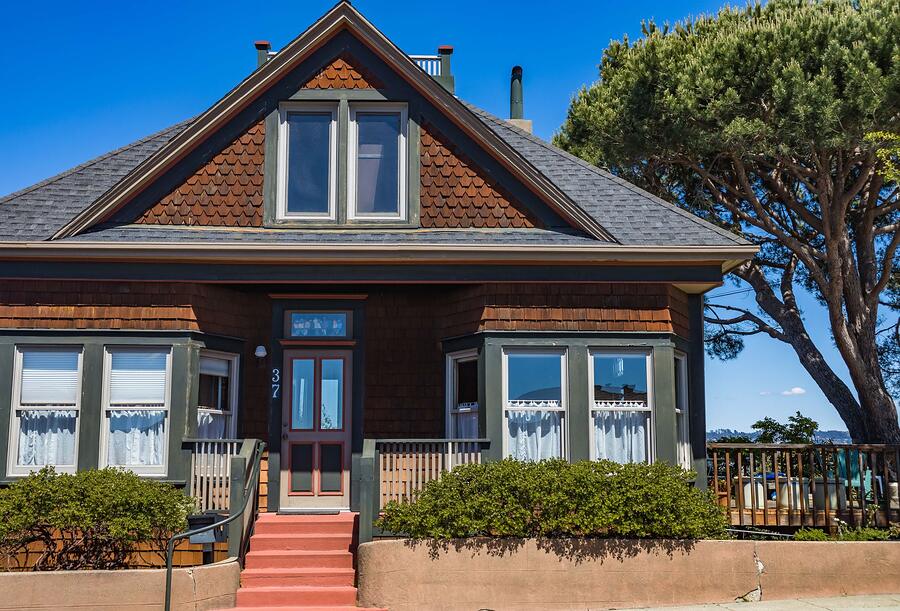
Hillside ranch houses toward Mount Helix back onto trees and slopes
La Mesa's growth years were the 1950s and 1960s, when the population climbed from under eleven thousand in 1950 toward the sixty thousand it holds today, and the ranch houses from that period run up the slopes toward Grossmont and Mount Helix. These houses have low-pitched roofs with open eaves, attached garages, and lots that were cut into hillsides, so the back of the house often meets a bank planted in ivy or iceplant with a mature tree above it. The University of Florida extension service describes roof rats as arboreal animals that travel along branches, wires and palm trunks and range around 150 yards from the nest. On a hillside lot that radius takes in a dozen back yards, the slope behind the fence and whatever fruit trees survive from the citrus era.
The mid-century houses on the Mount Helix side are also where a homeowner meets the tile-roof problem. Many were reroofed in concrete tile in the 1980s and 1990s, and the gap under the first course of tile at the eave is a named building component with a named closure, the bird stop. A crushed or missing bird stop leaves a rat-sized void along the whole eave, and the US Department of Energy lists bird stopping among the measures it recommends for tile roofs. The metal closure is the fix; a bead of foam is the thing that fails. Roof rat removal on these houses runs trapping in the attic alongside the eave closure, in that order or together.
What We Handle in La Mesa
La Mesa calls come in for roof rats in the attic, sealing on raised-foundation bungalows and hillside ranch houses, and cleanup after a long infestation.
- Roof rat removal: snap trapping on the runs in a Village bungalow attic or a hillside ranch, with traps left at least a week because UF/IFAS notes the species is wary of anything new.
- Rodent exclusion: hardware cloth at foundation vents and rafter bays, metal bird stops on the tile-roofed houses, and a fitted closure on the crawl space hatch.
- Rodent inspection: free, covering attic, crawl space, roofline and the slope behind the house, with each part of the work priced on its own line.
- Attic cleanup: removal of droppings and soiled insulation from attics that have carried rats through several winters.
- Attic insulation replacement: fresh insulation where runs have flattened the old fill, since the Department of Energy states that compressed insulation falls short of its rated value; this work is routed to a contractor with the CSLB license for it.
- Dead rodent removal: locating a carcass in a wall or under a raised floor after a bait treatment.
- Poison-free rodent control: trapping and sealing in place of the anticoagulant baits that California law has taken off the residential list.
A Typical La Mesa Job
The situation: A retired couple in a 1920s bungalow a few blocks from the Village hear scratching under the bedroom floor at night and a heavier thump in the ceiling above the kitchen. It began after the first October rain. Their daughter told them it is probably the neighbor's cat on the roof. Neither of them has slept properly in a week, and the feeling that something is living inside the walls of a house they have owned for forty years is worse than the noise.
What gets done: The inspection finds two foundation vents on the north side with the screen rusted through, a crawl space hatch that no longer closes flush, and an open rafter bay at the back corner of the roof under a pepper tree limb. Roof rat droppings, a quarter to a half inch long and pointed at the ends, lie along a joist in the crawl space and along the top plate above the kitchen. The contractor we route sets traps in the crawl space and attic, fits quarter-inch hardware cloth to the vents and the rafter bays, leaves the hatch as the last opening until the traps go quiet, then closes it with a fitted metal panel. The couple has the pepper limb cut back off the roof.
How it turns out: The traps catch for the first week and then stop, the follow-up visit finds no new droppings, and the report lists each sealed point with a photograph. The house is quiet at night and it is theirs again.
What This Costs in La Mesa
Most La Mesa rodent jobs fall inside the national bands below, and the free inspection tells you which lines a specific house needs.
| Work | National band (HomeGuide 2026) |
|---|---|
| Inspection | Free here; $0 to $175 standalone elsewhere |
| Trapping and removal | $250 to $1,200 |
| Full-home exclusion | $500 to $2,500 |
| Attic cleanup and decontamination | $600 to $2,500, to about $4,000 for a severe attic |
| Insulation removal and replacement | $2.50 to $5.50 per square foot |
| Dead rodent removal | $150 to $500 |
| Full-scope restoration | $3,000 to $10,000 and up |
These are HomeGuide's 2026 national figures; there is no La Mesa cost survey to quote, so treat them as typical-job bands that the inspection turns into one number for one house. A raised-foundation bungalow with a crawl space adds the under-floor sealing line that the national guides price and that slab houses skip, which is the main thing that moves a Village job up the exclusion band. A hillside ranch with a tile eave and one open rafter corner sits lower. Ask whoever attends for trapping, sealing and cleanup as separate lines, and ask what the sealing warranty covers and for how long.
Mice, squirrels, or something else
How the signs differ between the two.
Video: Signs of Mice vs. Squirrels In Your Attic, from Skedaddle Humane Wildlife Control.
Common Questions in La Mesa
What callers from La Mesa ask before they book.
How long does it usually take to get rid of rats in La Mesa?
Two to three weeks is typical for a La Mesa house once trapping and sealing start together. HomeGuide's 2026 guide gives two to three days of trapping for a few animals and a month or two for a severe infestation, and UF/IFAS advises leaving traps at least a week because roof rats are wary of new objects. A raised-foundation house with an open crawl space and an open attic can sit toward the longer end because there are two spaces to clear. The sealing is what keeps the timeline from starting again next October.
Can the company just put poison out under the house?
Anticoagulant bait is mostly off the table at a California home. AB 1788 removed the second-generation anticoagulants from residential use in 2021 and AB 1322 added diphacinone in 2024, according to the California Department of Pesticide Regulation. What a licensed company may still use is narrow, and a rat that feeds and then dies inside a crawl space or wall is the outcome a bait plan invites. Trapping plus sealing is the standard answer for a La Mesa house, and it is why the quote should show those two lines.
My house sits on a crawl space. Does that change the work?
It adds the foundation to the list of things that get sealed. Many of the older La Mesa houses near the Village and along the older streets sit on raised foundations, so the foundation vents, the sill line and the crawl space hatch are entry points alongside the roofline. Quarter-inch hardware cloth in 18 to 22 gauge, which the County of San Diego recommends, goes on every vent, and the hatch gets a fitted closure. The crawl space also gets checked for droppings and for a carcass if the smell suggests one.
Who is licensed to trap rats in San Diego County?
Rodent control at a home is Branch 2 work under the California Structural Pest Control Board, and every company we route into La Mesa holds the Branch 2 registration the job requires. Ask for the company's PR number and confirm it at pestboard.ca.gov before work starts. Roof rats and house mice are non-native species, so no wildlife permit is needed to trap them. If the job grows into attic insulation replacement, that part is routed to a contractor holding the CSLB license for it.
Book the free La Mesa inspection and get each line priced before anything starts.
Nearby Areas We Serve
The same contractors cover the cities around La Mesa, and the service area is the whole of San Diego County.

Book a Free Inspection in La Mesa
A free inspection on a La Mesa house shows where the rats are getting in, at the roof or under the floor, and what it costs to close each point. The phone is answered 24 hours a day.