
About Rodent Removal San Diego
One phone number, answered around the clock, that puts a San Diego homeowner in front of a registered rodent contractor with a free inspection and an itemized quote.
- Downtown office on West Broadway
- San Diego County coverage
- Registrations you can verify
What the phone line is for
A dispatcher answers the number on the page around the clock. What that call is for is to pin down the problem: the room the noise sits over, the hour it starts, how many nights it has run, and whether there is fruit on a tree, a canyon edge or an open crawl space nearby. That is usually enough to name the species and to decide whether the first visit is a routine roofline walk or something that needs a quicker slot.
The nearest registered contractor is then lined up for a free inspection, and the inspection is what you are really getting. It takes in the roofline, the attic, the crawl space where the house has one, the interior signs and the yard, with every opening recorded and photographed. The quote is built from those notes, trapping, sealing and cleanup each on its own line.
The office is at 402 W Broadway, Suite 400, in Emerald Plaza downtown. Anything in writing goes through the contact form, and no quote is ever issued from a form by itself.
What to expect on the job
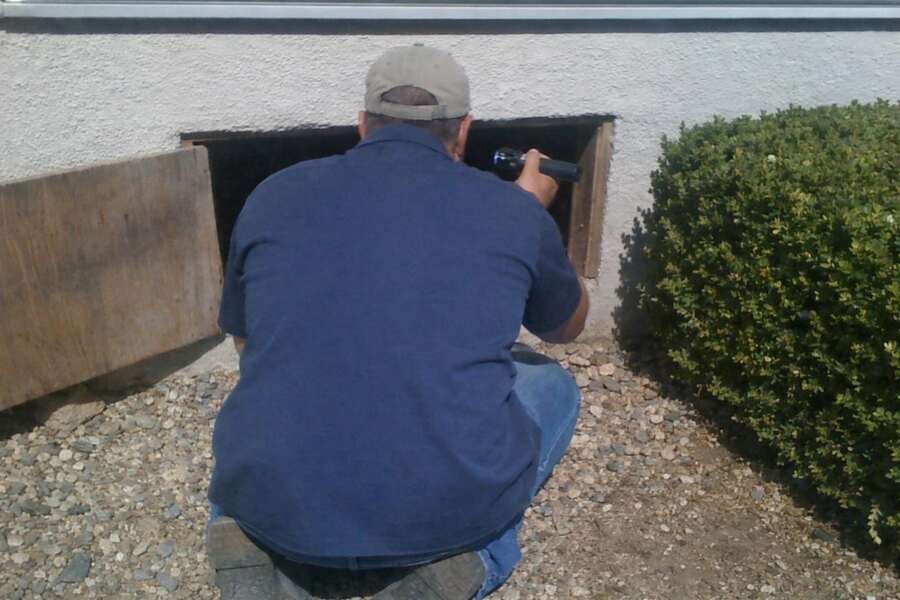
Expect a ladder at the eave before anyone goes into the attic, because on a San Diego house the way in is above head height, and expect a crawl through the foundation vents on the older stock, because the second way in is below the floor. Tile eave courses, open rafter bays, gable screens, foundation vents and the sleeves where lines pass through stucco are checked first, then the attic for droppings, rub marks and flattened insulation runs.
Expect the sealing to be explained before it is sold. The county's own guidance is quarter-inch hardware cloth of 18 to 22 gauge and metal weather stripping, and on tile a code-approved bird stop along the eave is the part that holds; expanding foam on its own is what a cheap quote usually means. Expect the traps to be left in place a week or more, because UF/IFAS notes that roof rats avoid unfamiliar objects, and expect the final openings to stay open until the traps have gone quiet.
Expect no second-generation anticoagulant bait at a home, because AB 1788 has prohibited it there since 2021, and expect a plain answer on how long it takes. The national cost guides put trapping a handful of animals at two to three days and a severe infestation at one to two months, and the sealing is what gives that timeline an end.
The registrations to check before work starts
Rodent control for hire in California is Branch 2 work under the Structural Pest Control Board, part of the Department of Consumer Affairs. The board licenses applicators, field representatives and operators, and every one of them has to work for a registered structural pest control company that carries a PR number. Attic insulation replacement performed as a contracted repair is a separate matter: it falls under the Contractors State License Board, typically a B or C-2 license.
Every contractor we route holds the registration its part of the job requires. Ask whoever attends for the company PR number and confirm it at pestboard.ca.gov, ask the insulation contractor for the CSLB number and confirm it at cslb.ca.gov, and ask to see proof of insurance. Checking a registration takes two minutes online, and a contractor who balks at being asked for the number has answered a different question.
Homeowners who have been through it pass on three more questions. Which items sit inside the quoted figure and which are billed on their own. How many return visits that price covers. And what happens, in writing, if rodents turn up again after the sealing was signed off.
Where contractors are dispatched
The City of San Diego and the rest of San Diego County. The canyon-rim districts of Mission Hills, Kensington, Talmadge and North Park produce the most roof rat calls, the mid-century streets of Clairemont and Point Loma produce open-eave work, and the tile-roof suburbs from Scripps Ranch to Rancho Bernardo produce eave closures. La Jolla and the coast carry the palm and ivy pressure. Each has its own page under locations, as do the surrounding cities from Chula Vista and La Mesa to Escondido, Carlsbad and Oceanside.
Commercial properties near the bay, the port and the older commercial blocks, where Norway rats occasionally burrow, are covered under commercial rodent control.
What the call gets you
A dispatcher first, then a registered contractor
The number is answered around the clock by a dispatcher whose job is to work out what has happened at the property and get the response moving. You describe the noise, the room, the time of night and how long it has gone on, and the nearest contractor with the Branch 2 registration is lined up for a free inspection. Nothing is quoted over the phone and nothing is sold from a form.
Phone answered 24 hours a day
The eave and the crawl space are the job
A San Diego house is entered at the roofline and, on the older raised-foundation stock, at the foundation vents and the sill line. Tile eaves without a bird stop, open Craftsman rafters, gable screens and the sleeves where lines pass through stucco are the usual list. The University of Florida extension puts the rat-proofing standard at a quarter inch, and that is the size the sealing is checked against.
Quarter-inch rat-proofing standard, UF/IFAS Extension
Plain numbers, labeled by source
HomeGuide's 2026 national bands are printed on every service page and labeled as national, because no San Diego cost survey exists to cite. A homeowner who knows that trapping and removal typically lands between $250 and $1,200 nationally can tell a padded quote from a fair one and ask why a figure sits outside the band.
Trapping and removal $250 to $1,200, HomeGuide 2026
What happens after you call
Five steps, the same on every job, with the sealing in the middle where it belongs.
-
Call and describe it
Where the noise is, what time of night, how long, and what you have found. That narrows the species before anyone drives out.
-
Free inspection
Roofline, attic, crawl space, yard and trees walked, every opening recorded, an itemized quote written from it.
-
Seal the unused openings
Hardware cloth, sheet metal and tile eave closures shut everything except the runs still in use, so nothing is trapped inside a wall.
-
Trap the animals still inside
Snap traps on the active runs, left at least a week because roof rats are wary of new objects, checked and reset.
-
Close the last runs and restore
Once activity stops, the final openings are closed and the attic is cleaned or re-insulated where the damage calls for it.

Ready to stop the scratching?
Ring at any hour, or use the form and the dispatcher phones back to set up the free inspection.